
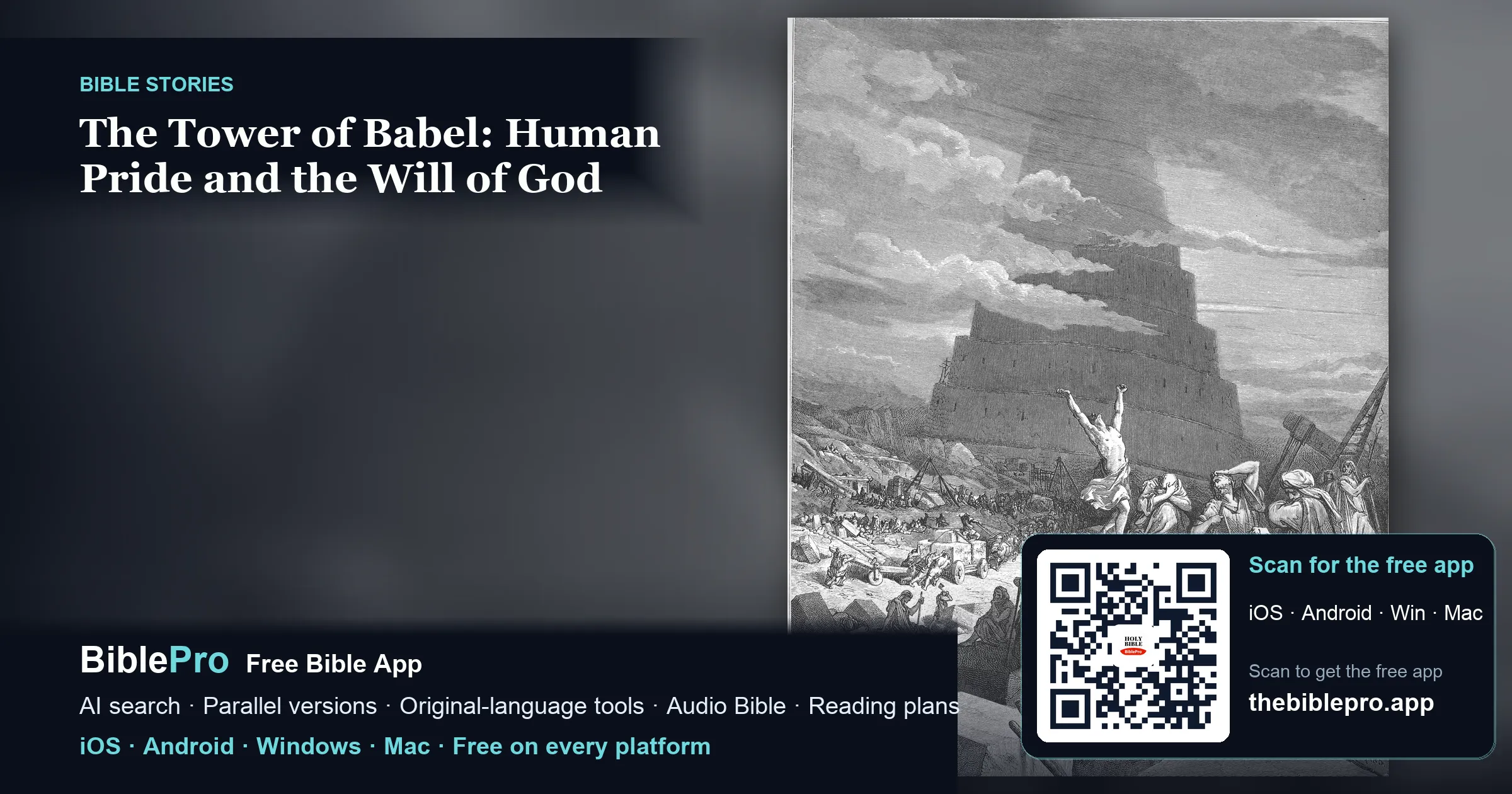
After the flood, humanity multiplied once more upon the earth. Yet the corruption within the human heart had not been washed away with the waters. On the plain of Shinar, the people gathered and set their hearts on a single great undertaking—to build a tower that would reach the sky, so that they might make a name for themselves. The story of the Tower of Babel is one of the great peaks of the first eleven chapters of Genesis. Like a mirror, it reveals human pride, and it reveals God's sovereignty and love.
One Language, One Speech
Genesis tells us that in those days everyone on earth shared a common language and could communicate with one another without barriers. This was a beautiful gift from God, meant to let people worship in unity and love one another. Sadly, they turned that very unity in the wrong direction.
And the whole earth was of one language, and of one speech.Genesis 11:1 (KJV)
A Tower to Reach the Heavens
They journeyed eastward, came to the plain of Shinar, and settled there. They learned to make bricks, using brick for stone and tar for mortar. Advancing technology is a good thing in itself, but their ambitions steadily swelled. No longer looking up to the God of heaven, they wanted to build—by the strength of their own hands—a city with a tower whose top would reach heaven.
And they said, Go to, let us build us a city and a tower, whose top may reach unto heaven; and let us make us a name, lest we be scattered abroad upon the face of the whole earth.Genesis 11:4 (KJV)
“Let Us Make Us a Name”
These words lay bare the pride buried deep in the human heart. What they treasured was their own reputation, not the glory of God; they wanted to stand by their own power rather than humbly lean on the Lord who created them. This is the very heart of sin—putting man in the place of God, wanting to be gods themselves.
They also said, “lest we be scattered abroad upon the face of the whole earth.” Yet God's original command had been that people should “be fruitful, and multiply, and replenish the earth.” This human “unity” was in fact open defiance of God's will, an attempt to fence themselves firmly into one place behind a tower.
The LORD Came Down to See
The people imagined their tower soared into the clouds, nearly touching heaven. But in God's sight, how small that tower was—so small that Scripture uses a deeply ironic turn of phrase: God had to “come down” in order to see what they had built. Such is human greatness before God.
And the LORD came down to see the city and the tower, which the children of men builded.Genesis 11:5 (KJV)
Confused Language, Scattered Abroad
God did not send a flood, nor did He rain down fire. He simply confused their language, so that they could no longer understand one another's speech. Once their words were confused, the unity in their hearts collapsed in an instant, and the unfinished tower had to be abandoned. So God scattered them from there over all the earth, and they named the city “Babel,” which means “confusion.”
Within God's judgment, His mercy was hidden. Had proud humanity been left to unite without limit, the evil they committed would only have grown deeper and deeper. God's confusing and scattering of them actually held back a far greater corruption, and taught people once more to learn humility and reverence.
Pride and Salvation
The story of Babel is a portrait of every human religion—people forever trying to “climb up to heaven” by their own efforts, to reach God and to accomplish their own salvation. Yet Scripture tells us that the road to heaven is not built by man; it is the road God Himself has prepared for us. God did not stop at judgment. In the very next chapter, chapter twelve, He called Abraham, so that through his offspring all the families of the earth would be blessed.
The God who scattered the people is also the God who would gather them again. At Pentecost the Holy Spirit came down, and people from every nation, speaking every kind of language, all understood the gospel—the curse of Babel was overturned and healed in the grace of Christ.
We Today
Babel reminds every one of us: whoever exalts himself will be humbled, and to the humble God gives grace. True honor does not come from how high a tower we raise for ourselves, but from whether we are willing to give the glory to God. May we no longer lift up our own name, but honor His name alone.
May you open the book of Genesis and read this ancient yet living account for yourself. You are welcome to use the chapter-by-chapter parallel feature in the BiblePro app to read Genesis 11 side by side; you can also use AI Search to explore themes like “Babel,” “unity,” and “humility,” letting God's word take root in your heart. And may you find a local church where you can worship together with brothers and sisters, supporting one another and growing together in the truth.
In this series
- 1In the Beginning, God Created — The Story of Creation in Genesis
- 2The Fall of Man: Temptation in Eden and the First Promise of Salvation
- 3Cain and Abel: The World's First Tragedy Born of Envy
- 4Noah's Ark and the Great Flood: Grace in Judgment and the Covenant of the Rainbow
- 5The Tower of Babel: Human Pride and the Will of God
- 6The Altar of Isaac: The LORD Will Provide a Lamb
- 7Jacob's Ladder: The Grace That Met a Fugitive (Genesis 28)
- 8Joseph in Egypt: You Meant Evil, but God Turned It to Great Good
- 9Flame in the Bush: Moses and the Call That Would Not Burn Out (Exodus 3)
- 10The Ten Plagues of Egypt: The LORD Reveals to Pharaoh That He Is the True God
- 11The Passover Lamb: When I See the Blood, I Will Pass Over You
- 12Crossing the Red Sea: Stand Still and See the Salvation of the Lord
- 13Thunder and Fire on Sinai: The Ten Commandments and God's Covenant of Love
- 14The Golden Calf: The Idol Below the Mountain and Moses' Plea
- 15The Twelve Spies' Choice: Faith or Fear (Numbers 13-14)
- 16The Bronze Serpent Lifted High: A Picture of Salvation, One Look and You Live
- 17Balaam's Donkey: When God Turned a Curse into a Blessing
- 18Rahab and the Two Spies: The Scarlet Cord in the Window
- 19The Walls of Jericho Fall: When Obedience Is Mightier Than the Sword
- 20Hannah's Prayer: Giving Back to God What We Treasure Most
- 21Samuel Anoints David: The Lord Looks at the Heart
- 22David and Goliath: The Battle Is the LORD's
- 23David and Jonathan: A Covenant Love That Laid Down Its Own Rights
- 24David Spares Saul Twice: Leaving Vengeance in God's Hands
- 25You Are the Man: Nathan Confronts David
- 26Glory Fills the Temple: The House Solomon Built for the LORD
- 27Fire on Mount Carmel: Elijah Confronts the Prophets of Baal
- 28Elijah and the Widow of Zarephath: Faith in the Last Handful of Meal
- 29Naaman's Leprosy: The Humility He Learned in the Jordan
- 30Jonah and the Great Fish: The Turnaround of a Runaway Prophet
- 31The Fourth Man in the Fiery Furnace: Three Young Men Who Would Not Bow
- 32Daniel in the Lions' Den: Praying Three Times a Day and God's Deliverance
- 33The Writing on the Wall: A Kingdom Weighed in a Single Night (Daniel 5)
- 34Esther: Who Knows Whether You Have Come to the Kingdom for Such a Time as This?
- 35The Wise Men Follow the Star: Worship with Gold, Frankincense, and Myrrh
- 36The Transfiguration: A Glimpse of Glory Before the Cross
- 37Living Water at the Well: Jesus and the Samaritan Woman
- 38The Ten Lepers: Why Only One Came Back
- 39Zacchaeus Climbs the Sycamore: An Outcast Found by the Lord
- 40Pentecost: The Day the Church Was Born
- 41Stephen the First Martyr: The First to Die for the Lord
- 42Philip and the Ethiopian Eunuch: A Gospel Appointment on a Desert Road
- 43The Light on the Damascus Road: How Saul Became the Apostle Paul
- 44Peter and Cornelius: The Door of the Gospel Opens to the Gentiles
- 45Songs at Midnight, an Earthquake at Dawn: Salvation in Paul and Silas's Prison Cell
- 46Paul's Storm at Sea: The Miracle on the Island of Malta
Carry deeper Bible study in your pocket
BiblePro brings AI-powered search, parallel translations, original-language tools and reading plans together — free to download, so you can study deeply anytime, anywhere.